


We only use functional cookies for the operation of the webshop. For optimal functioning, please click on accept.
Pressure measurement
Hydraulic pressure measurement for maintenance and diagnostics
Reliable pressure data supports safe commissioning, accurate adjustment and efficient fault diagnosis. Select the instrument, measuring range and connection for the expected pressure profile, hydraulic fluid and operating environment.
Pressure measurements provide valuable information about the load and resistance within a hydraulic circuit. Measuring at carefully selected points can help assess the operation of pumps, valves, actuators, filters and pipework, provided the readings are interpreted together with flow, temperature and the circuit design.
Leeuwtechniek supplies mechanical pressure gauges with lower or back connections, pressure gauge valves, hydraulic test kits, gauge snubbers, digital pressure gauges, sensors and test couplings. These products support both permanent indication and temporary measurements during service, commissioning and troubleshooting.
Reliable pressure indication
A correctly selected mechanical gauge or electronic sensor shows whether pressure remains within the intended operating range at the measuring point.
More effective diagnostics
Test couplings, test hoses and portable instruments make it easier to compare pressures and identify abnormal pressure losses or transients.
Pressure measurement equipment
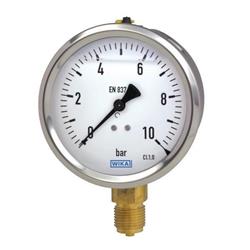
Lower-mount pressure gauges
Mechanical gauges with the process connection at the bottom, suitable for direct mounting where the installation and vibration conditions permit.
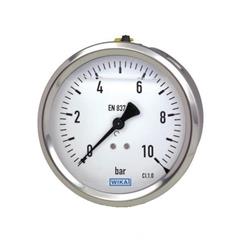
Back-mount pressure gauges
Gauges with a rear process connection, commonly used for panel mounting and compact instrument layouts.
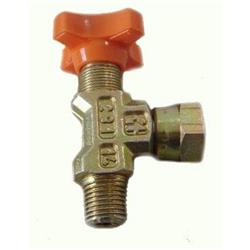
Pressure gauge valves
Valves for isolating a gauge from the hydraulic circuit. Venting or pressure relief is only possible when provided by the selected valve design.
Hydraulic test kits
Portable sets for pressure checks and diagnostics during maintenance, commissioning and field service.
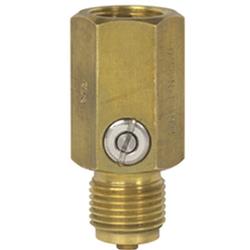
Pressure gauge snubbers
Protective accessories that restrict rapid pressure pulsations before they reach the instrument, improving readability and reducing dynamic loading.
Digital gauges and sensors
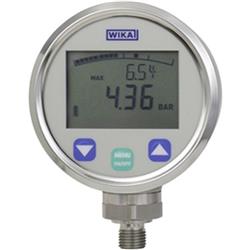
Electronic instruments for digital indication and, depending on the model, multi-channel measurement, peak capture or data logging.
Test couplings
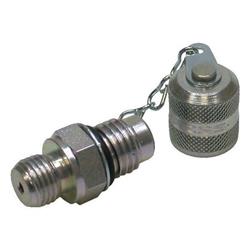
Compact measuring points for temporarily connecting compatible test hoses, pressure gauges or electronic pressure sensors.
Typical applications
- Machine building
- Mobile hydraulic equipment
- Agricultural machinery
- Construction equipment
- Commercial vehicles and transport equipment
- Industrial installations
- Marine and offshore systems
- Service and preventive maintenance
- System commissioning
- Fault diagnosis and condition checks
A permanently installed gauge may be sufficient for routine local indication. Service engineers often benefit from a portable test kit with compatible hoses and adapters. Electronic instruments are usually more appropriate when several measuring points must be compared or when pressure transients need to be captured.
Why measure hydraulic pressure?
Hydraulic pressure reflects the resistance or load acting on the fluid at a particular point in the circuit. A pump primarily supplies flow; pressure develops as that flow meets resistance. A pressure reading must therefore be evaluated in the context of actuator load, valve settings, flow rate, temperature and the circuit configuration.
Measurements at several points can help identify excessive pressure loss, incorrect valve settings, restrictions, leakage or abnormal component behaviour. A pressure reading alone does not always identify the cause, but it is an important part of a structured diagnostic process.
Preventive maintenance
Trend measurements can reveal changes before they result in poor performance, unplanned downtime or damage.
System adjustment
Suitable instruments support the controlled adjustment and verification of pressure-control and pressure-relief functions.
Fault location
Comparing readings at selected test points can help narrow down the location of restrictions, leakage or malfunctioning components.
Which measuring solution suits your application?
| Measuring solution | Typical use | Important selection criteria |
|---|---|---|
| Mechanical pressure gauge | Direct local pressure indication | Scale range, accuracy class, case size, connection, mounting position, material and dry or liquid-filled design |
| Pressure gauge valve | Isolation and, where designed for it, controlled venting of a gauge | Thread, pressure rating, fluid compatibility, valve function and installation space |
| Hydraulic test kit | Portable servicing and measurements on different machines | Pressure ranges, instruments or sensors, hose ratings, couplings and adapters |
| Pressure gauge snubber | Reducing the effect of pressure pulsations on the gauge | Pressure rating, fluid, material, connection, temperature and required damping response |
| Electronic measuring equipment | Digital diagnostics and recording of changing pressures | Range, accuracy, overload capability, sampling rate, channels, sensor type and logging requirements |
| Test coupling | Temporary, repeatable access to a measuring point | Connection thread, rated pressure, seal, compatible mating coupling and test hose |
Lower or back connection
A lower-mount pressure gauge has its process connection at the bottom of the case. This arrangement is commonly used for direct mounting on pipework, manifolds and hydraulic components, subject to the permissible vibration and mechanical loading.
A back-mount gauge has the process connection at the rear. It is often more suitable for panel mounting or when the connection must be routed behind the instrument. Select the connection position, mounting hardware and dial orientation together.
Liquid-filled pressure gauges
Liquid-filled gauges use a case filling, often glycerine in suitable temperature ranges, to damp pointer movement caused by vibration and moderate pulsation. The filling can improve readability, lubricate the movement and help reduce condensation inside an appropriately constructed case.
The fill fluid and instrument must suit the ambient temperature and application. A liquid-filled gauge does not automatically protect against severe pulsation, pressure spikes or sustained overpressure. A suitable snubber, restrictor, valve or different instrument design may also be required.
More stable pointer movement
Case filling reduces pointer oscillation and can make the indicated pressure easier to read in vibrating applications.
Reduced internal wear
Damping and lubrication can reduce wear of the measuring movement when the gauge is used within its specified limits.
Test couplings and temporary measuring points
Test couplings provide compact access points for service measurements. A compatible test hose, pressure gauge or sensor can be connected when a reading is required, avoiding the need for a permanently installed instrument at every location.
Connection under pressure is product-specific. Follow the manufacturer's instructions and pressure limits for the complete measuring chain, including the test coupling, mating connector, hose, adapters and instrument. Keep the measuring point clean and fit its protective cap after use.
Pressure gauge snubbers
Hydraulic pumps, switching valves, rapid load changes and machine vibration can create pulsating pressure. Pointer flutter makes a mechanical gauge difficult to read and increases the dynamic load on its measuring movement.
A pressure gauge snubber restricts rapid pressure changes before they reach the instrument. The correct restriction depends on the fluid viscosity, temperature, connection and pressure dynamics. A snubber is not a substitute for a correctly selected system pressure-relief device and may not capture every extremely fast transient.
Digital pressure measurement
Digital pressure gauges and sensors are useful when a clear numerical display, higher resolution, peak capture, multiple measuring channels or data logging is required. Model-specific functions and accuracy must always be checked in the technical data.
Digital indication
A numerical display can provide clear readings and may offer selectable engineering units, depending on the instrument.
Multiple measuring points
Multi-channel instruments can compare pressure before and after a component or at different locations in the circuit.
Recording and analysis
Compatible instruments may store measured values for trend analysis or investigation of intermittent faults.
Dynamic measurements: an instrument can only capture a pressure transient when the sensor response, sampling rate and recording settings are fast enough for the event being investigated.
How to select pressure measurement equipment
- Establish the normal pressure, maximum pressure and possible transient peaks.
- Select a measuring range that complies with the instrument manufacturer's limits for steady and fluctuating pressure.
- Define the required accuracy, resolution and response time.
- Check thread type, connection size and sealing method.
- Decide whether indication is permanent or temporary.
- Select the connection position, case size and mounting method.
- Account for vibration, pulsation and pressure spikes.
- Choose dry, liquid-filled, mechanically damped or electronic measurement as appropriate.
- Check fluid compatibility, temperature and environmental conditions.
- Verify the rated pressure of every hose, coupling, adapter, valve and instrument.
Connections and sealing
Reliable measurement starts with a compatible connection. Verify the thread standard, size, sealing surface and specified seal. A connection that appears to fit can still have a different thread form or sealing principle, creating leakage, thread damage or an unsafe assembly.
Support the instrument and connecting hose so that their weight, vibration and movement do not overload the measuring point. Keep the assembly accessible for inspection and install it without forcing or cross-threading the connection.
Measuring hydraulic pressure safely
- Use only equipment rated for the maximum pressure, transients, temperature and hydraulic fluid.
- Depressurise and secure the system whenever required for connection or removal.
- Inspect gauges, sensors, hoses, couplings and adapters before every use.
- Never use hands or other body parts to search for high-pressure leaks.
- Keep equipment and personnel clear of moving machine parts and foreseeable hose-failure paths.
- Open isolation valves slowly and in a controlled manner.
- Do not loosen a connection until trapped pressure has been safely relieved.
- Follow the machine, instrument and site-specific safety procedures.
Inspection and calibration
Inspect instruments for impact damage, leakage, unreadable scales, case-fill loss and an incorrect zero indication. Check test hoses for kinks, abrasion, ageing and damaged end connections. Keep couplings and sealing surfaces clean.
Overpressure, transients, vibration, contamination and intensive use can affect performance. Calibrate instruments at an interval based on the required measurement confidence, usage, criticality, manufacturer recommendations and applicable quality procedures. Remove damaged or suspect equipment from service.
Frequently asked questions about pressure measurement
Which pressure gauge do I need for my hydraulic system?
Select it according to the normal and maximum pressure, pressure dynamics, required accuracy, connection, mounting position, case size, fluid, temperature and environmental conditions. Check the manufacturer's permissible loading for steady and fluctuating pressure.
What is the difference between lower and back mounting?
A lower-mount gauge has its process connection at the bottom. A back-mount gauge has the connection at the rear and is commonly used for panel mounting or compact layouts.
Why use a pressure gauge snubber?
A snubber reduces the effect of rapid pressure pulsations on the instrument. This can stabilise the reading and reduce dynamic wear, but it is not a general overpressure-relief device.
What is the benefit of a liquid-filled pressure gauge?
The case filling dampens pointer movement caused by vibration and moderate pulsation, lubricates the movement and can improve readability. Severe pressure dynamics may still require additional protection.
What are hydraulic test couplings used for?
They provide compact measuring points for temporarily connecting compatible test hoses, pressure gauges or electronic sensors. Observe the pressure ratings and connection procedure for the complete measuring system.
When should I choose electronic measuring equipment?
Electronic instruments are useful when digital indication, higher resolution, peak capture, multiple channels or data logging is required. For fast events, verify the sensor response and sampling rate.
Can I add a measuring point to an existing system?
Often yes, using a suitable test coupling, adapter or intermediate component. The modification must be engineered for the connection, pressure, fluid, available space and safety requirements of the system.
Order pressure measurement equipment from Leeuwtechniek
Leeuwtechniek supplies dry and liquid-filled pressure gauges, pressure gauge valves, hydraulic test kits, gauge snubbers, digital pressure gauges, sensors and test couplings for hydraulic systems.
Always consult the product-specific technical data. If you are unsure about the measuring range, accuracy, connection, mounting method, pressure rating or accessories, Leeuwtechniek can help you compare suitable options.
Need help selecting pressure measurement equipment?
Our specialists can help you compare pressure gauges, test couplings, hydraulic test kits, snubbers and electronic instruments for your application.
Call +31 38 421 80 23
Reliable pressure measurement for hydraulic systems.
From pressure gauges and test couplings to hydraulic test kits, digital pressure gauges and sensors. Explore professional equipment for maintenance, fault diagnosis and commissioning of hydraulic systems.