
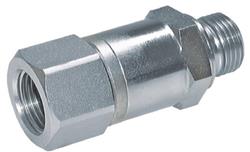
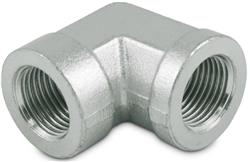
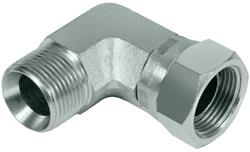
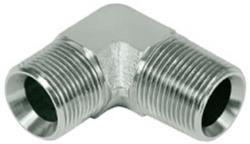
Connecting different systems
Adaptors provide a safe transition between connections with different thread types, sizes, orientations or sealing methods.
Reliable connection solutions for joining different thread types, connection sizes and components in hydraulic and industrial systems.
Hydraulic adaptors are used to connect pipes, hoses, valves, pumps, cylinders and other components safely. They make it possible to combine different connection sizes, thread types and sealing methods within a single system.
Leeuwtechniek supplies adaptors and reducing fittings for a wide range of hydraulic applications. The range includes straight adaptors, elbows, tee adaptors, bulkhead fittings, male-to-male adaptors, female-to-female adaptors, plugs, caps, swivel fittings and components for JIC, ORFS, BSP, NPT and metric connections.
Adaptors provide a safe transition between connections with different thread types, sizes, orientations or sealing methods.
The correct adaptor helps create a clear and compact hydraulic circuit without unnecessary hoses, welding or complex pipe modifications.
Adaptors are used in new systems, maintenance, repairs and modifications to existing installations. They are particularly useful when components with different end connections need to be joined, provided that the thread form, dimensions, sealing method, materials and pressure ratings are compatible.
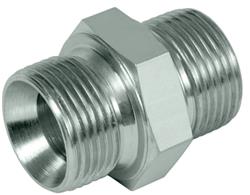
Straight fittings with male threads at both ends, used to connect two components with female threads.
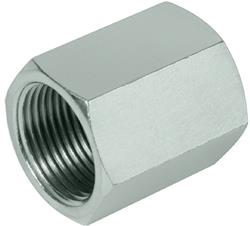
Fittings with female threads at both ends, used to connect two male-threaded components.
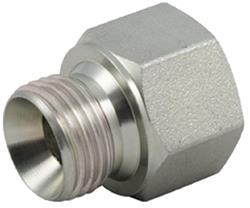
Combine male and female threads to create a transition between two components.
Provide a transition between different thread sizes within the same or a different thread family.
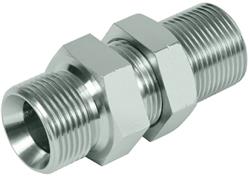
Pass through a wall, plate or panel to create a fixed, mechanically supported connection.
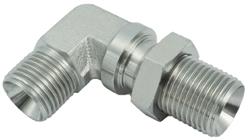
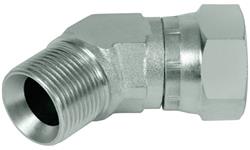
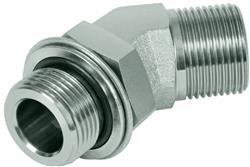
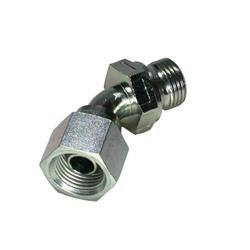
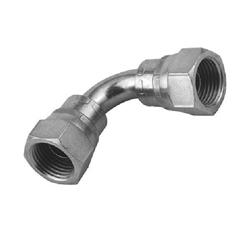
Change the direction of flow and allow compact pipe or hose routing where installation space is limited.
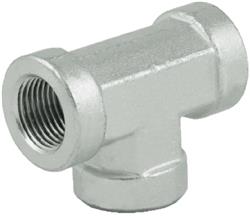
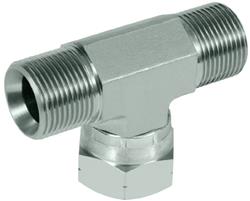
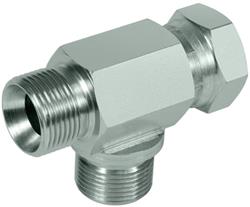
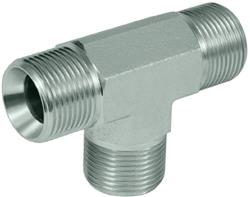
Split or combine a flow path when an additional branch connection is required.
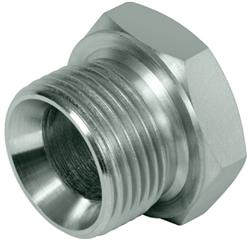
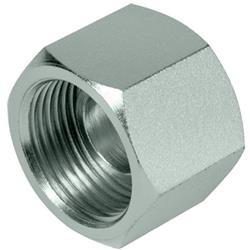
Close unused connections and protect the system against leakage and contamination.
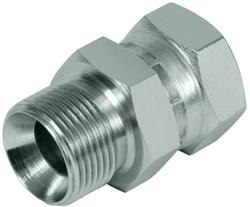
Connections that simplify assembly by allowing the nut or connection to rotate during installation, helping to prevent hose twist. They are not necessarily suitable for continuous movement during operation.
When selecting an adaptor, the thread type is at least as important as the nominal size. Threads can have very similar diameters while differing in pitch, thread angle, taper and sealing method.
Widely used in European hydraulic and industrial systems. Available with parallel or tapered threads.
A tapered thread commonly found in North American systems and internationally manufactured machinery.
Seals on a 37-degree flare and is widely used in mobile hydraulics and machinery.
A flat-face connection with an O-ring, suitable for systems requiring a high level of leak tightness.
Widely used for cutting-ring fittings, components and European hydraulic systems.
SAE standards cover several distinct hydraulic connection systems, including 37-degree flare, O-ring boss, O-ring face seal and flange connections. Always identify the specific connection type and sealing method.
An adaptor can seal in several ways. The thread itself is not always the sealing surface. Depending on the system, the seal may be formed within a tapered thread, at a metal cone or flare, at an O-ring face, or by a sealing washer.
| Sealing method | Characteristic | Important consideration |
|---|---|---|
| Tapered thread | The seal is formed within the threaded connection | Use only a sealant approved for the specific thread and fluid, and avoid overtightening |
| Tapered seat | Seals against a metal cone or flare | Check the angle, size and sealing surfaces for damage |
| O-ring face seal | An O-ring seals against a flat surface | Check the O-ring material and groove |
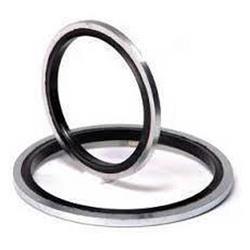
| Sealing washer | A washer seals beneath a shoulder or head | Use the correct washer and replace damaged washers |
Widely used in hydraulic systems for its high mechanical strength. Suitability for a specific pressure depends on the fitting design, size and pressure rating.
Suitable for wet, corrosive and chemically demanding environments.
Used for water, air, low-pressure systems and general industrial applications.
A suitable surface treatment can improve the corrosion resistance of steel adaptors. Suitability depends on the coating, environment, fluid and maintenance conditions.
The internal flow area of an adaptor affects the pressure loss within the system. An undersized bore increases the flow velocity and can cause heat generation, noise and efficiency losses.
Do not select an adaptor on thread size alone. Also check the internal bore and the required flow rate. Local pressure losses can be higher in elbows, tee adaptors and reducing adaptors than in a straight connection.
Straight adaptors are suitable when two components are aligned. Elbow adaptors change direction and can improve hose routing. Swivel adaptors and swivel fittings simplify assembly and can help prevent a hose from twisting during tightening.
Do not assume that a standard swivel adaptor is suitable for continuous rotation. Use a purpose-designed live swivel when movement or rotation occurs during operation, and always follow the product specifications.
Clean all connections before installing the adaptor. Dirt, metal particles or thread sealant residue can enter the hydraulic system and damage pumps, valves or cylinders.
Use the correct tools on the spanner flats and avoid transferring installation forces through adjacent components. With elbow and tee adaptors, take the required final orientation into account. Use adjustable versions where necessary.
An adaptor generally requires little maintenance. If leakage is detected, depressurise the system and inspect the complete connection. Replace damaged seals and any adaptor showing thread damage, deformation, severe corrosion or cracking.
BSPP is parallel, whereas BSPT, NPT and NPTF are tapered. BSP and NPT/NPTF also differ in thread angle and often in pitch, so they must not be combined without a correctly specified transition adaptor.
A JIC connection seals on a 37-degree flare. Always check the size and thread specifications before combining components.
ORFS uses a flat-face O-ring seal and provides a high level of leak tightness when correctly assembled.
No. Only connections that seal on the thread may require a thread sealant. Do not apply tape to cone-, flare- or face-sealing connections unless specified by the manufacturer.
Measure the thread, determine its pitch and check the profile using suitable measuring tools or a thread chart.
Use a bulkhead fitting when a hydraulic connection must pass through a wall, frame or panel and requires mechanical support.
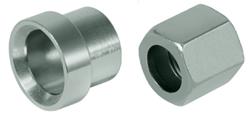
Leeuwtechniek supplies hydraulic adaptors, reducing fittings, nipples, elbows, tee adaptors, bulkhead fittings, plugs, caps, swivel fittings, nuts, washers and seals for a wide range of applications.
Always consult the technical product data. If you are unsure about the thread type, sealing method, pressure class, material or size, Leeuwtechniek can help you select the right adaptor for your system.
Hydraulic adaptors for reliable connections.
Explore hydraulic adaptors for connecting different thread types, sizes and connection types. Suitable for maintenance, machinery and equipment manufacturing, and the installation or modification of hydraulic systems.